The honey year
What blooms, when
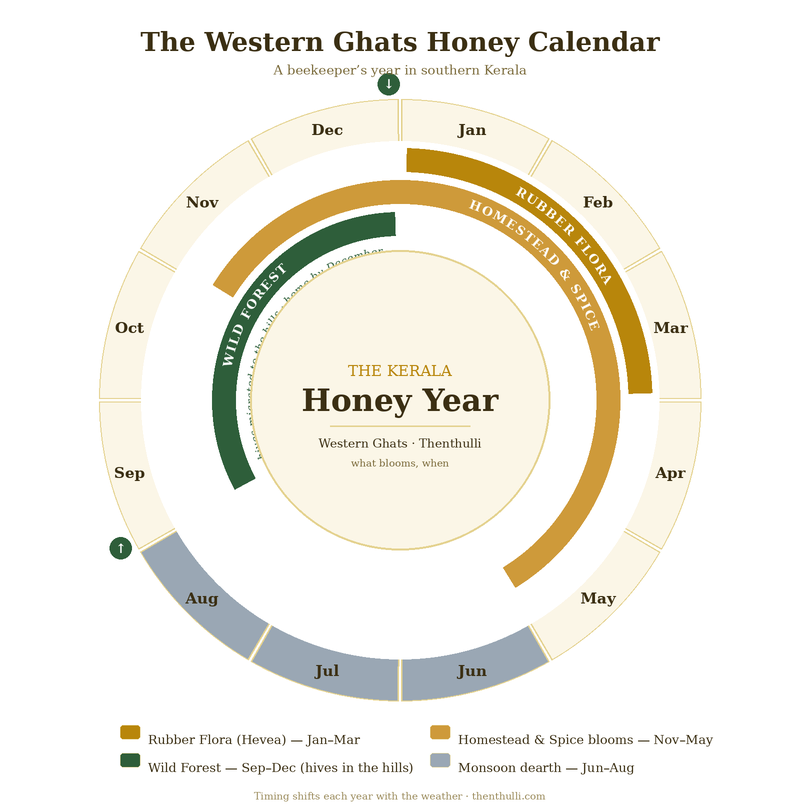
Our bees follow the blooms, and the blooms follow the seasons. After the monsoon we migrate our hives into the mountain ranges for the wild forest bloom, and bring them home in December.
Raw, unblended honey from our own hives in the hills around Trivandrum — cold-extracted, never pasteurised, and traceable to the bloom it came from.
One of the most biodiverse landscapes on earth. Our hives sit among rubber estates, homestead gardens and the forest edge of the Agasthyamala hills.
Apis cerana indica and Tetragonula iridipennis — the bees that belong to these hills. We move with them too, migrating to the mountains for the post-monsoon forest bloom.
Cold-extracted and gravity-strained, never pasteurised or ultrafiltered. Every batch dated to its season and lab-tested against FSSAI standards.
Our family has kept bees in Kerala since 1975. Thenthulli carries that half-century of craft into every jar — tended by hand, harvested only when the comb is fully capped, and bottled without pasteurising so the living enzymes, pollen and aroma survive the journey to your table.
From the rubber estates that flush gold in February to the wild forest blooms of the Agasthyamala range, we simply bottle what these hills offer, honestly.
Read our storyOur bees follow the blooms, and the blooms follow the seasons. After the monsoon we migrate our hives into the mountain ranges for the wild forest bloom, and bring them home in December.
We wait for fully capped, ripe comb
Cold extraction at ambient temperature
Gentle gravity strain, not ultrafiltered
Batches kept separate by source & season
Lab-tested against FSSAI standards
Bottled in food-grade glass
Kerala’s rare stingless-bee honey — why it’s so scarce, and how to spot the real thing.
Read →
The Kerala honey that doesn’t come from flowers — it comes from leaves.
Read →
What FSSAI standards and NMR tests really mean — and why crystallisation is a good sign.
Read →
Harvest announcements, recipes from Kerala kitchens, and stories from our beekeepers. No noise — just honey.