Honey is a landscape you can taste — and a calendar you can follow. In the Western Ghats, the bees don’t work at random; they follow the blooms, and the blooms follow the seasons. Learn the rhythm of the year here, and you understand why one honey is pale and mild while the next is dark and wild. Here is the beekeeper’s year in southern Kerala.
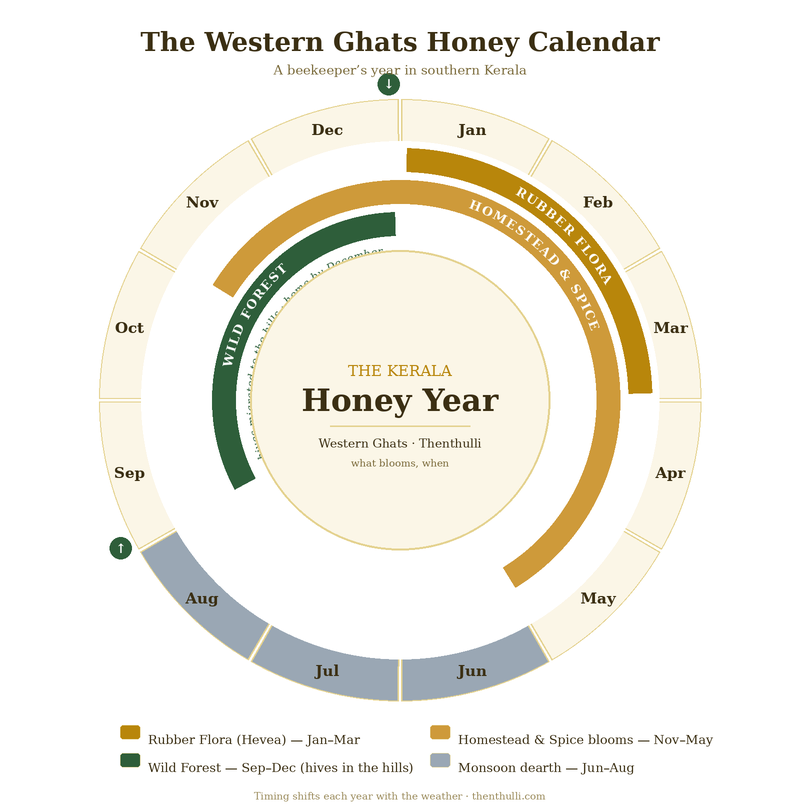

January to March — the rubber flush
The year opens with our signature flow. As the rubber trees shed old leaves and push out tender new ones, glands on the young leaves weep a steady, sugar-rich nectar for a few short weeks. The bees work it intensely, and we harvest our pale, mild Rubber Flora Honey. It’s a brief, single-origin window — miss it and you wait a year. What is rubber honey? →
Roughly November to May — homestead & spice blooms
Across much of the drier, cooler half of the year, Kerala’s homesteads and plantations carry the bees. Coconut palms, coffee and cardamom, tamarind, moringa, tulsi and a hundred garden flowers open in overlapping waves, feeding the colonies and lending their own quiet notes to the honey. This is the steady backbone of the beekeeping year.
June to August — the monsoon dearth
Then the southwest monsoon arrives, and the rain changes everything. Bees can’t forage in heavy downpours, and fewer plants flower. This is the “dearth” — the lean season when colonies live on the stores they built earlier. A good beekeeper’s job now is not to harvest but to leave the bees enough honey to carry them through. Respecting the dearth is part of keeping bees honestly.
September to December — the wild forest bloom (and the migration)
As the rains ease, the forests of the Western Ghats answer with a flush of wild flowering — trees, shrubs and climbers blooming in waves across the hills. Honey gathered now is multifloral, darker, thicker and far more aromatic: our Wild Forest Honey. Because the forest never blooms the same way twice, no two seasons taste alike.
This is also the season we move. Once the rains ease, we migrate our colonies up into the mountain ranges to meet that wild flowering where it is richest, and we keep them there through the bloom — bringing them home again in December as the flow tapers. Hives travel at night, when the bees are inside and settled. It is hard, unglamorous work, and it is the only way to gather true wild forest honey in any quantity. On the wheel above, the two green markers show it: ↑ September, hives migrate to the hills; ↓ December, hives return home. Shop Wild Forest Honey →
Why the calendar matters to what’s in your jar
This is the heart of single-origin honey. Blended commodity honey erases the calendar — pour everything together and every jar tastes the same, all year, forever. We do the opposite: we keep each flow separate, name its season and source, and let the year express itself. When you taste the difference between our spring rubber honey and our post-monsoon forest honey, you’re tasting the Western Ghats keeping time.
Curious which bees follow this calendar for us? Meet them on Our Bees & the Western Ghats.